0086-18057388688


100% Cotton Flocked Terry: The Complete Technical & Industry Guide
100% cotton flocked terry is one of the most technically refined constructions in modern knitted textiles. Combining the absorbency of natural cotton loops with the tactile precision of a flocked surface finish, it occupies a unique position across apparel, home textiles, and performance wellness markets. This guide examines its fiber science, structural mechanics, finishing chemistry, key specifications, and commercial applications — drawing on production knowledge from Zhejiang Guocheng Linen Knitting Co., Ltd (ZOCHAN), one of China's leading knitted fabric specialists.
1. What Is 100% Cotton Flocked Terry?
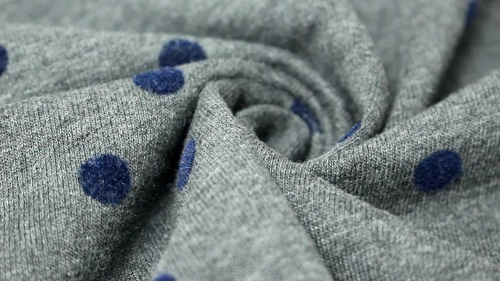
Terry fabric is a loop-pile knitted or woven structure in which extra yarn is intentionally floated above the ground construction to form characteristic loops. When that base fabric is 100% cotton and then subjected to a flocking process — the electrostatic or mechanical application of short textile fibers to an adhesive-coated surface — the result is a cotton flocked terry. The flocked layer adds a velvet-like, micro-textured hand feel on one or both faces of the fabric while retaining the moisture-management capacity of the cotton terry underneath.
The distinction between standard cotton terry and flocked terry is primarily one of surface engineering: in standard terry the loop pile is preserved and exposed; in flocked terry the surface is uniformly covered by upright short fibers (the "flock"), which creates a denser, more insulating, and visually refined appearance.
Key Definition
Flocking is the process of depositing thousands of short fibers — typically 0.3 mm to 3 mm in length — onto an adhesive surface under an electrostatic field, causing them to stand perpendicularly to the base fabric. On cotton terry, this process upgrades the tactile character without eliminating the absorbent performance of the underlying construction.
2. Fiber Science: Why 100% Cotton Matters
Cotton is a cellulosic fiber composed primarily of alpha-cellulose (~90%), with traces of water, wax, pectin, and protein. Its molecular structure — long, flat, and ribbon-like with a natural twist — creates two critical advantages for terry constructions: high moisture regain (standard regain: 8.5% at 65% RH) and strong capillary action along the fiber axis. These properties make cotton loops extremely efficient at both absorbing and releasing moisture.
For flocked terry specifically, 100% cotton as the base fiber also means:
| Property | Cotton Value / Range | Significance for Flocked Terry |
|---|---|---|
| Moisture Regain | 7–8.5% | Underlayer retains absorbency below flock coat |
| Tenacity (dry) | 3.0–5.0 g/denier | Withstands industrial washing with adhesive intact |
| Elongation at break | 3–7% | Low stretch stabilises the flock adhesion layer |
| Heat resistance | Up to ~150 °C (no melt) | Compatible with high-temp adhesive curing cycles |
| Dyeability | Reactive, vat, direct dyes | Vibrant base colors enhance flock visual effect |
| Biodegradability | Fully biodegradable | Supports end-of-life sustainability credentials |
| Skin compatibility | Hypoallergenic (natural) | Suitable for sensitive-skin and infant product lines |
| Sources: Textile fiber science literature and manufacturer technical data, April 2026. | ||
The absence of synthetic co-fibers in 100% cotton construction means the flock adhesive must be selected with particular care — polyurethane-based binders typically offer the best balance of flexibility and wash durability without compromising the natural breathability of the cotton ground.
3. Terry Fabric Construction: Knit Architecture
Knitted terry fabric is produced on a circular knitting machine equipped with sinker technology. During knitting, sinkers hold down the ground loops while a separate set of yarns is fed at higher tension to form the pile loops. The resulting fabric has:
- Ground structure: A plain jersey base providing dimensional stability.
- Pile loops: Extending above the ground on one face (single-face terry) or both faces (double-face terry).
- Loop height: Typically 1.5 mm – 4 mm, controllable by sinker depth setting.
For flocked terry, the pile loops may be sheared to a uniform height before flocking, creating a more consistent adhesive substrate. Alternatively, they may be left uncut (loop-back terry) if the flock is applied only to the face side, using the opposite loop structure for thermal bulk and softness.
At ZOCHAN's cotton & blended knit range, cotton terry structures are produced in weights from 150 g/m² to 355 g/m², with the heavier constructions (such as the flagship DD1508217 at 355 g/m²) providing the dense loop base most compatible with industrial flocking.
4. The Flocking Process: Electrostatic Fiber Application
4.1 Adhesive Preparation
The cotton terry base fabric is first padded or knife-coated with an aqueous adhesive formulation. For textile applications, water-based polyurethane (PU) or polyacrylate binders are standard. The adhesive must penetrate the top of the terry structure without saturating the full depth of the loops — excessive adhesive penetration will reduce the softness and absorbency of the finished product.
4.2 Flock Fiber Characteristics
The flock itself — when maintaining the 100% cotton claim — is produced from short-cut cotton fibers or viscose/rayon (cellulosic) fibers. Cotton flock fibers are cut to precise lengths:
| Flock Length | Surface Feel | Abrasion Resistance | Typical Application |
|---|---|---|---|
| 0.3 – 0.5 mm | Ultra-fine, suede-like | Moderate | Premium apparel facing, intimate garments |
| 0.5 – 1.0 mm | Soft, velvety | Good | Robes, lounge wear, baby textiles |
| 1.0 – 2.0 mm | Dense pile, plush | Very good | Bath towels, spa textiles, upholstery |
| 2.0 – 3.0 mm | Deep pile, high bulk | Excellent | Industrial wipers, thermal linings |
| Data derived from standard flock textile production parameters; April 2026. | |||
4.3 Electrostatic Deposition
In the electrostatic flocking chamber, the adhesive-coated fabric passes through a high-voltage field (typically 40,000–80,000 V). Charged flock fibers are attracted perpendicularly to the grounded fabric surface, embedding their bases into the adhesive. The perpendicular orientation of the flock is what creates the characteristic upright pile — visually uniform and tactilely consistent.
4.4 Curing and Finishing
After deposition, the fabric travels through a curing oven (120–160 °C for 1–3 minutes depending on adhesive type and fabric weight) to cross-link the binder. Excess unattached flock is vacuumed off, and the fabric may then undergo secondary finishing — calendering, anti-pilling treatment, or enzyme washing — to optimize hand feel and dimensional stability.
5. Technical Specifications & Standard Parameters
| Parameter | Standard Range | Premium / Performance Range |
|---|---|---|
| Fiber Composition | 100% Cotton | 100% Combed / Organic Cotton |
| Yarn Count (base) | 20S – 32S | 32S – 50S (finer hand) |
| Fabric Weight (GSM) | 200 – 320 g/m² | 320 – 450 g/m² |
| Fabric Width | 150 – 175 cm | 175 – 200 cm (wide-width loom) |
| Flock Fiber Length | 0.5 – 1.5 mm | 1.5 – 3.0 mm |
| Flock Density | ≥ 300 g/m² applied | ≥ 450 g/m² applied |
| Washing Durability (flock adhesion) | 20–30 industrial washes | 50+ washes (PU binder) |
| Shrinkage (after 3 washes @ 40 °C) | ≤ 5% | ≤ 3% (pre-shrunk / sanforized) |
| Colour Fastness (washing, ISO 105-C06) | Grade 3–4 | Grade 4–5 |
| Pilling Resistance (Martindale) | Grade 3 | Grade 4–5 |
| Moisture Absorption (base terry layer) | 300–450% by weight | 450–600% (combed ring-spun base) |
| Note: Values are indicative industry benchmarks. Exact specifications depend on production parameters, yarn quality, and finishing recipe. For custom specifications, contact ZOCHAN directly. | ||
6. Commercial Applications
The combination of the moisture-absorbent cotton terry base and the sensory-optimized flocked surface creates a fabric with unusually broad application scope:
6.1 Apparel & Intimate Wear
Bathrobes, lounge sets, and spa wraps represent the most commercially significant apparel category. The flock layer delivers the silky initial touch that premium hotel and wellness brands require, while the underlying terry construction provides absorbency for genuine functionality. Infant bodysuits and sleep sacks increasingly specify cotton flocked terry because both layers are hypoallergenic and free of synthetic fibers.
6.2 Home & Hospitality Textiles
Bath towels, face cloths, and bath mats produced in flocked terry command premium shelf positions due to their differentiated hand feel. In the hotel segment, flocked terry towels are a recognized quality marker. ZOCHAN's linen terry fabric range and their cotton polyester linen terry fabric illustrate the variety of construction philosophies available for home textile buyers seeking bespoke terry solutions.
6.3 Technical & Medical Textiles
Absorption pads, surgical drapes, and patient gowns benefit from cotton flocked terry's combination of liquid management and low-lint surfaces. The flock layer can reduce fiber shedding — a significant advantage in sterile environments — while the cotton base ensures non-irritating contact with skin.
6.4 Performance Sportswear & Wellness
Yoga towels, gym wipes, and post-workout robes utilize the rapid moisture-uptake of the cotton loop substrate. When the flock is applied only to the non-contact side, the product can maintain a slip-resistant surface (flock) while keeping the skin-facing side as soft cotton terry loops.
7. Sustainability Credentials
In 2026, sustainability certification is no longer optional for textiles entering European and North American retail channels. 100% cotton flocked terry, when produced responsibly, can carry multiple certifications:
| Certification | Scope | Relevance to Flocked Terry |
|---|---|---|
| GOTS (Global Organic Textile Standard) | Organic fiber + processing | Applies if organic cotton base and non-toxic adhesives used |
| OCS (Organic Content Standard) | Organic fiber tracking | Confirms 100% organic cotton content in base fabric |
| OEKO-TEX Standard 100 | Harmful substance limits | Critical for flock adhesive compliance; binder must pass |
| GRS (Global Recycled Standard) | Recycled content | Applicable if recycled cotton flock fibers are used |
| BLUESIGN® | Resource efficiency + safety | Covers dyeing and adhesive application chemistry |
| ZOCHAN holds GOTS, OCS, GRS, and OEKO-TEX certifications across its organic content and recycled content product ranges. | ||
Zhejiang Guocheng's organic content range demonstrates that producing certified knitted fabrics at scale is commercially viable, including for cotton-based structures that form the substrate for flocked finishing. Their recycled content line further shows that circular-economy principles are being integrated across the product portfolio.
8. Care, Laundering, and Long-Term Performance
The dual-layer nature of flocked terry introduces care requirements not present in standard terry goods. Buyers and end-users should observe the following guidelines:
| Care Step | Recommendation | Reason |
|---|---|---|
| Wash temperature | 30 °C – 40 °C | Higher temps can weaken PU binder adhesion |
| Detergent type | Mild, pH-neutral | Alkaline detergents accelerate adhesive degradation |
| Spin cycle | Low / gentle | Prevents flock fiber mechanical abrasion |
| Tumble drying | Low heat (max 60 °C) | Excessive heat affects binder flexibility |
| Ironing | Avoid direct iron on flock face | Heat + pressure can crush flock pile permanently |
| Bleaching | Never bleach | Destroys flock fibers and adhesive chemistry |
| Dry cleaning | Not recommended | Solvent-based cleaning dissolves most flock adhesives |
9. Market Trends and Industry Outlook
The global premium terry fabric market is expanding, driven by the growth of wellness tourism, luxury home goods, and the sustainable fashion movement. Cotton flocked terry is positioned at the intersection of several macro-trends:
Natural fiber premiumization: Consumers and brands are moving away from polyester-dominant terry in favor of natural cotton constructions, especially in the post-pandemic era of heightened tactile awareness.
Surface innovation: Flocking technology allows manufacturers to differentiate product aesthetics without changing yarn composition — a cost-effective route to premiumization.
Sustainable sourcing pressure: Retailers and brands are tightening supply chain transparency requirements. As a manufacturer with over a decade of specialization in knitted natural-fiber fabrics, ZOCHAN is well-placed to meet these demands — especially given the company's certified organic and recycled fabric ranges alongside its core cotton and linen product lines.
Buyers seeking a more technical overview of the broader knitted fabric landscape are encouraged to explore ZOCHAN's industry insights — including articles on knitted fabric structure, types, and applications and fiber science and construction performance — which provide deep technical grounding relevant to adjacent fabric categories.
10. Sourcing Cotton Terry and Related Knits from ZOCHAN
Zhejiang Guocheng Linen Knitting Co., Ltd, trading as ZOCHAN, was established in 2011 in Tongxiang City, Jiaxing, Zhejiang Province — a region synonymous with China's advanced textile manufacturing cluster. The company specializes in knitted fabric production with particular depth in natural-fiber constructions.
Their product range most relevant to cotton flocked terry sourcing includes:
Cotton & Blended Fabrics Organic Content Fabrics Linen Terry Fabric Cotton Polyester Terry Linen Blend Terry
ZOCHAN supports custom development — including composition adjustments, weight variations, width specifications, and bespoke finishing recipes — and can supply fabric under OCS, GOTS, GRS, and OEKO-TEX certifications depending on buyer requirements.
Request Samples or a Custom Quote
ZOCHAN's technical team works directly with designers, brands, and fabric distributors worldwide to develop optimal cotton terry solutions for your application.
Contact ZOCHAN →